Robot Joint Motor Selection: Frameless Torque Motor Checklist for Cobot and Humanoid Actuators
How robotics teams should evaluate frameless robot joint motors by torque density, hollow-shaft routing, reducer fit, thermal rise, torque ripple, and prototype risk.
Robot joint motor selection is a packaging problem, a thermal problem, and a control problem at the same time. A compact actuator can fail even when the motor torque number looks correct, because the reducer, bearing, encoder, cable path, and housing all compete for the same space.
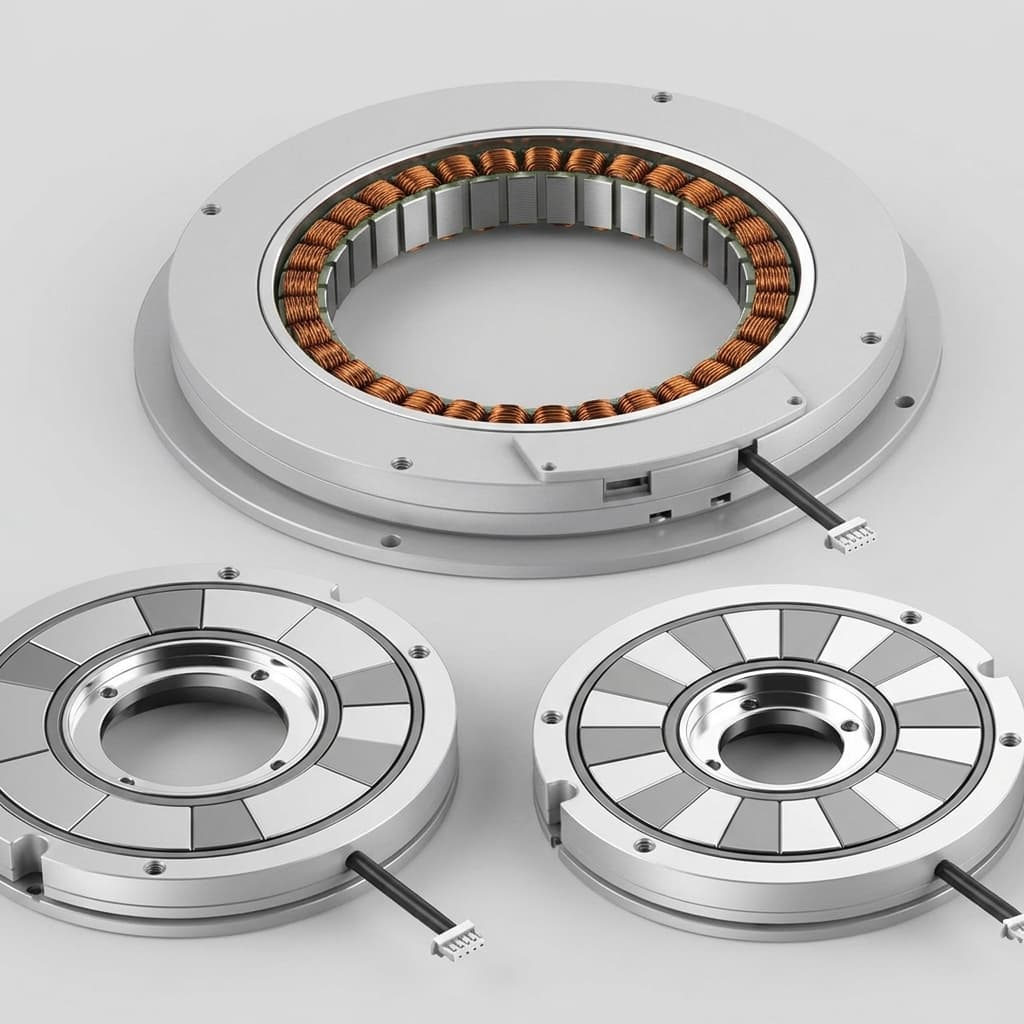
For cobots, humanoid robots, exoskeletons, and compact servo joints, frameless torque motors are often the right architecture because they allow the motor to be integrated directly into the joint.
Below is the checklist I use when a robotics team sends an early actuator layout and asks whether a compact frameless motor path is realistic.
Robot joint actuator stack
Motor selection changes when reducer, bearing, encoder, and cable path compete for the same space.
Before comparing motor options, define the actuator stack:
Design item
RFQ note
Joint type
Shoulder, elbow, wrist, hip, knee, ankle, end effector, or exoskeleton axis.
Reducer
Direct-drive, harmonic, strain-wave, planetary, cycloidal, or custom reducer.
Cable path
Through-shaft, side exit, external routing, or sealed connector.
Encoder
Center aperture, side mount, bearing-integrated, or motor-side feedback.
Bearing layout
Determines available ID and rotor support method.
Housing material
Affects heat transfer and stator retention method.
If your team is still changing bearing or reducer size, tell the supplier. That saves time because OD/ID changes can affect the motor design more than small torque adjustments.
Motor speed, inertia, and reducer input torque matter
Planetary reducer
Cost-effective torque multiplication
Backlash and package length
Motor speed and shaft/interface compatibility matter
Custom integrated joint
Best package optimization
Higher engineering coordination
OD/ID, encoder, bearing, housing, and wiring must be reviewed together
Many robot teams start with a reducer because it shrinks motor torque requirements. But the reducer does not remove the need to check thermal behavior and smoothness. It only changes which motor parameters dominate.
Robotics teams often ask for the smallest possible motor with the highest torque. The limit is usually heat.
Ask these questions early:
What continuous torque is possible with our housing material?
Is the quoted value based on natural convection, forced cooling, or mounted housing conduction?
What winding temperature limit is assumed?
Will the stator be bonded, clamped, press fit, or potted?
Is the joint duty mostly short bursts or continuous holding?
For battery-powered robots, also ask about efficiency and current draw at typical operating points, not just peak output.
For a battery robot, ask for data at your normal operating point. A motor that can produce high peak torque may still consume too much current during repeated motion. This matters for runtime, drive temperature, and joint surface temperature.
Useful supplier question:
At [normal joint torque] and [normal joint speed], what winding and current range would you recommend for our bus voltage?
That question produces better engineering feedback than asking only for maximum torque.
Low cogging is important for collaborative robots and humanoids because the motor is part of the feel of the joint. Torque ripple can show up as vibration, poor force-control behavior, or difficult low-speed tuning.
For sensitive joints, include:
Low-speed operating range
Force-control or impedance-control requirements
Reducer ratio and expected reflected inertia
Encoder resolution
Acceptable vibration or torque ripple target
If you are building a direct-drive joint, torque ripple and smoothness become even more important because there is less mechanical filtering from a reducer.
Ask the supplier what can be tuned:
Pole/slot design or electromagnetic design target
Magnet skew or rotor/stator design approach
Winding and control assumptions
Encoder resolution recommendation
Test method for low-speed smoothness or torque ripple
Not every project needs a formal torque ripple test, but the supplier should understand why the topic matters.
Cable routing, encoder geometry, or a large bearing may require a larger ID. A large ID can reduce available electromagnetic area, so the motor may need a larger OD or stack length to keep torque.
Do not hide the pass-through requirement until late in the RFQ. Send the actual ID requirement and explain what must pass through it.
What is the first motor parameter to define for a robot joint?
Start with the real joint duty: continuous torque, peak torque, speed, reducer ratio if used, acceleration profile, and duty cycle. Motor OD and ID should be reviewed together with the reducer, bearing, encoder, cable route, and housing.
Why is torque density not enough for robot joint motor selection?
A high torque density motor can still fail if heat cannot leave the joint, if torque ripple is too high for force control, if the hollow-shaft path conflicts with the reducer, or if the winding does not match the drive current and bus voltage.
Should a cobot or humanoid joint use direct drive or a reducer?
Direct drive removes gearbox backlash but usually needs a larger motor and more current. A harmonic, strain-wave, planetary, or custom reducer reduces required motor torque but adds compliance, heat, cost, and reflected dynamics. The best choice depends on package size, smoothness target, payload, and duty cycle.
What should be checked before ordering robot joint motor samples?
Freeze the drawing revision, OD, ID, stack length, winding target, drive voltage/current, sensor plan, cable exit, mounting method, and sample acceptance tests. If the joint package is still changing, use staged samples instead of pretending the production design is fixed.
How should I describe smoothness requirements to a supplier?
Share the low-speed range, force-control or impedance-control requirement, reducer ratio, encoder resolution, vibration target if available, and whether the joint is direct-drive. Avoid vague wording such as high precision without a test method.
Author
Jimmy Su
Frameless torque motor sourcing and application engineering. 10+ years in industrial motion control supply chain between China and global OEM markets.