Frameless Torque Motor
Start inquiry
Frameless Torque Motor
Hollow-Shaft Torque Motor Integration for Gimbals, Rotary Tables, and Precision Automation
2026/06/06

Hollow-Shaft Torque Motor Integration for Gimbals, Rotary Tables, and Precision Automation

A buyer-side guide to using hollow-shaft frameless torque motors for optical gimbals, cable pass-through axes, indexing tables, and low-backlash direct-drive systems.

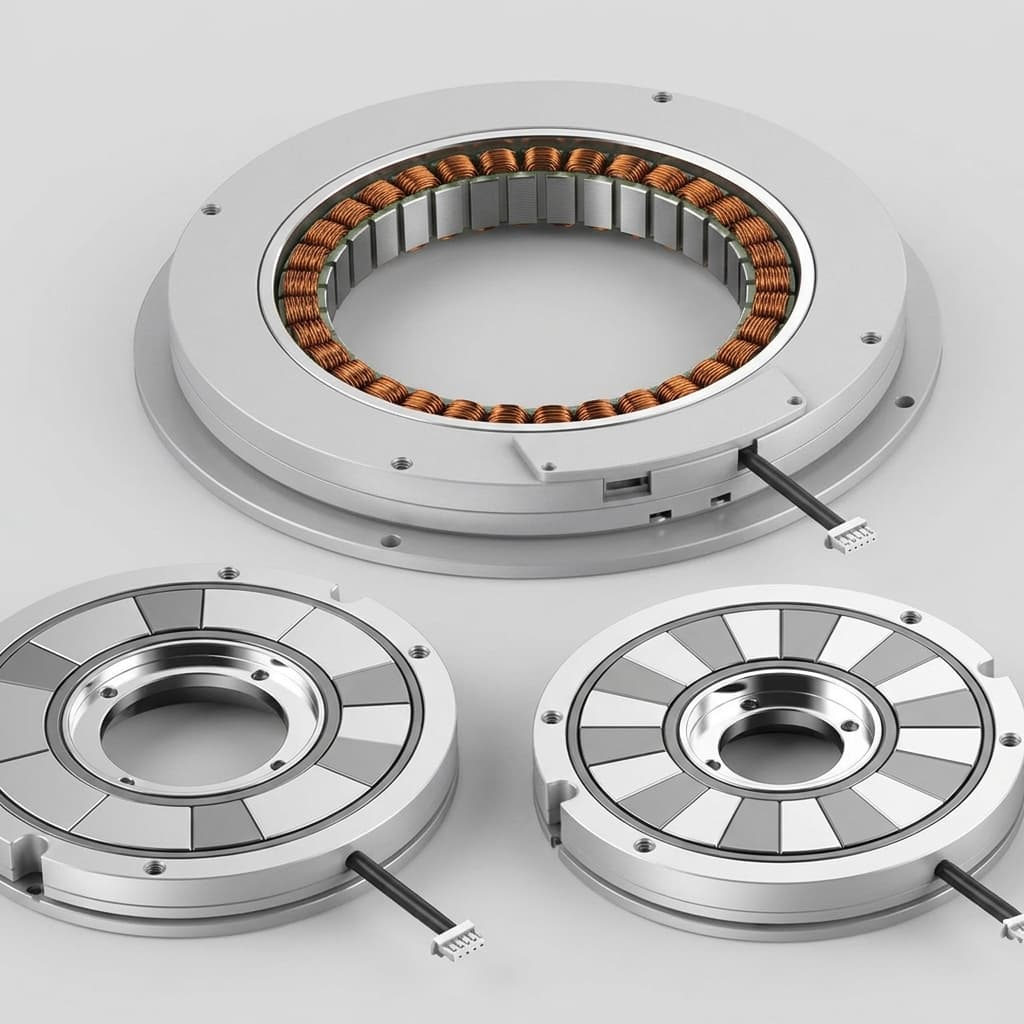
Hollow-shaft torque motors are used when the center of the axis must remain open. The opening may carry optics, cables, slip rings, vacuum lines, tooling, bearings, or encoder hardware.

For gimbals, rotary tables, inspection stages, and precision automation axes, a hollow-shaft frameless torque motor can remove gearbox backlash and keep the axis compact. The tradeoff is that mechanical integration must be planned carefully.

These are the items I check before treating a hollow-shaft torque motor quote as realistic, especially when the center aperture, smooth motion, and mechanical runout are as important as the torque number.

Hollow-shaft torque motor integration

Large aperture designs need early review of bore size, air gap, bearing reference, and rotor clamping.

Stator in housingHeat path and retention methodRotorClamping and axial retentionAir gapTolerance stack and inspectionHollow boreOptics, cables, slip ring, bearingA larger ID often requires more OD, stack length, cooling, or a lower torque target.

Buyer takeaways

TakeawayPractical meaning
Define the aperture before torque discussionThe required clear ID and what passes through it can change the motor family, OD, stack length, and winding direction.
Smoothness is application-specificGimbals care about pointing stability and vibration; rotary tables care about repeatability, indexing duty, and thermal repeatability.
Large ID trades against active motor areaA bigger opening may require more OD, more stack length, better cooling, or a lower torque target.
Mechanics control final accuracyBearing stiffness, housing concentricity, encoder layout, and air gap control determine whether the motor can perform as expected.
Installation planning is part of supplier qualificationRotor retention, magnet handling, lead routing, and post-assembly checks should be reviewed before samples ship.

Where hollow-shaft torque motors fit best

Common applications include:

  • Optical gimbals and stabilized payloads
  • Antenna pointing systems
  • Rotary indexing tables
  • Semiconductor inspection and positioning axes
  • Cable-through automation modules
  • Direct-drive rotary stages

The shared requirement is usually smooth rotary motion with a large aperture and low backlash.

Buyer decision map

Not every hollow-shaft axis has the same buying priority:

ApplicationPrimary valueMain RFQ risk
Optical gimbalSmooth pointing and cable/optical pass-throughTorque ripple, vibration, environmental assumptions
Antenna pointingLarge aperture and holding torqueThermal load during hold
Rotary indexing tableLow backlash and repeatable indexingTemperature rise over repeated cycles
Semiconductor inspection axisSmooth motion and stable geometryRunout, encoder compatibility, particle/process constraints
Cable-through automation modulePackaging and wiring simplicityID requirement reducing available motor torque
Slip-ring rotary axisOpen center and continuous rotationMechanical interface and lead routing

Use this table to decide what the supplier should optimize first. A gimbal motor conversation should not sound identical to a rotary table conversation.

Large ID changes the design conversation

A large inside diameter is valuable, but it reduces the space available for copper, magnets, and iron. The supplier may need to adjust:

  • Outside diameter
  • Stack length
  • Magnet grade
  • Pole count
  • Winding
  • Thermal path
  • Rotor support method

If the aperture is fixed by optics, a slip ring, or a bearing, send that exact value in the first RFQ. Do not describe it only as "large hollow shaft."

The ID/OD ratio is one of the first things to review. A large ID with a small OD leaves limited radial space for the active motor structure. In that case, the supplier may recommend:

  • Increasing stack length
  • Increasing OD if the housing allows
  • Reducing torque target
  • Improving cooling
  • Changing the winding
  • Using a different bearing or encoder arrangement

If OD cannot increase and stack length cannot increase, the realistic torque may be lower than expected. Discovering that before the mechanical design is frozen saves a painful redesign.

Gimbal buyers should define smoothness, not just torque

For optical and pointing systems, smoothness can be more important than raw torque.

Useful RFQ details include:

RequirementWhy it matters
Pointing speedDetermines voltage and back EMF requirements.
Holding torqueDefines continuous thermal load.
Disturbance torqueDefines peak margin.
Torque ripple targetAffects optical stability and control tuning.
Cable or optical pass-throughDrives ID and rotor geometry.
Environmental conditionAffects insulation, coating, and thermal assumptions.

If vibration or pointing stability matters, include the measurement target your team uses internally.

For gimbals, also clarify:

  • Is the motor holding position for long periods?
  • Is motion continuous, scanning, or step-and-hold?
  • Is there a counterbalance or external disturbance load?
  • Are cables routed through the center or around the axis?
  • Does the system need low acoustic noise?
  • Are there temperature, altitude, vibration, or sealing assumptions?

Avoid vague terms like "high precision" without a measurable target. If you cannot share a numeric target, describe the test method your team uses.

Rotary table buyers should focus on stiffness and thermal repeatability

For indexing tables and automation axes, the motor is only one part of repeatable motion. Bearing stiffness, encoder feedback, fixture inertia, and housing thermal behavior matter.

Ask the supplier to review:

  • Rotor inertia against acceleration time
  • Continuous torque at production duty
  • Temperature rise over repeated index cycles
  • Encoder and drive compatibility
  • Installation method for air gap control
  • Whether a torque-speed curve is available for the proposed winding

If the table runs many cycles per hour, continuous thermal behavior is more important than the highest peak torque number.

For a rotary table RFQ, include the cycle profile:

Cycle itemExample input
Index angle30 degrees, 90 degrees, 180 degrees, or continuous
Move timeAcceleration, cruise, deceleration
Payload inertiaFixture and workpiece inertia if known
Dwell timeTime between moves
Cycles per hourProduction duty
Positioning targetRepeatability and accuracy expectation

This lets the supplier discuss torque-speed and thermal behavior more realistically.

Installation risks to control

Hollow-shaft frameless motors usually require careful assembly because the rotor and stator are separate parts.

Control these risks before sample build:

  1. Air gap tolerance stack
  2. Rotor axial clamping method
  3. Magnet handling and fixture safety
  4. Lead wire routing and strain relief
  5. Housing concentricity and runout
  6. Post-assembly electrical checks

The installation guide covers these issues in more detail.

Air gap and runout deserve early attention

The air gap is the controlled space between rotor and stator. If the tolerance stack is poor, the motor can lose performance or suffer physical contact.

Ask these questions before sample build:

  • What air gap target or tolerance is assumed?
  • Which part of the customer housing controls concentricity?
  • How should rotor axial movement be prevented?
  • What runout target is needed for the bearing and rotor carrier?
  • How should the assembly be inspected after installation?

For precision axes, the motor supplier and mechanical team should review the stack together. A motor cannot compensate for an unstable bearing or housing reference.

When to request CAD and drawings

CAD helps after the motor family and aperture direction are known. For early discussion, share your envelope and ask for a preliminary drawing path. For later review, request:

  • 2D mounting drawing
  • STEP or IGES model
  • Lead wire exit position
  • Rotor/stator interface dimensions
  • Recommended air gap and assembly notes

Tie every CAD request to a project name and drawing revision. This reduces the risk of using the wrong model during mechanical design.

Supplier questions that improve quote quality

Ask these during the first supplier discussion:

QuestionWhy it matters
What is the largest practical ID for this OD and torque target?Checks whether geometry is realistic
What thermal condition supports continuous torque?Prevents overpromising in sealed axes
Can you provide torque-speed and temperature-rise data?Helps compare motor options
What CAD formats are available?Supports mechanical packaging
What assembly method do you recommend?Reduces air gap and magnet handling risk
What outgoing tests are available?Supports supplier qualification

For B2B programs, the quality of clarification questions often tells you more than the first quoted price.

Supplier question matrix

Use these questions to separate a useful engineering quote from a shallow price reply.

TopicAskUseful answer
Thermal basisWhat cooling condition supports the continuous torque?Housing/cooling assumption and temperature basis
Winding fitHow does the winding match our bus voltage and current limit?Kt, back EMF, current, speed, and drive comments
Mechanical integrationWhat mounting and air-gap control method do you recommend?Stator retention, rotor clamping, and inspection notes
ValidationWhat tests can be provided before production release?Back EMF, resistance, insulation, torque, thermal, outgoing record
CAD controlWhen can CAD be released and how is revision controlled?Model family, drawing revision, STEP/IGES scope

Example RFQ email for a hollow-shaft torque motor

Subject: Hollow-shaft torque motor RFQ for [gimbal / rotary table / automation axis]

Hello framelesstorquemotor.com engineering team,

We are evaluating a hollow-shaft frameless torque motor for [application].

  • Required clear ID and reason: [optics / cables / slip ring / bearing / tooling]
  • Maximum OD and stack length: [values]
  • Continuous torque, peak torque, and speed: [values]
  • Duty cycle: [hold / scan / index cycles per hour / continuous rotation]
  • Cooling method and housing material: [values]
  • Bearing, encoder, or slip ring constraints: [values]
  • Torque ripple, smoothness, vibration, or runout target: [values or TBD]
  • CAD format needed: [STEP / IGES / 2D drawing]
  • Prototype quantity and timeline: [values]

Please advise suitable model family, geometry risks, winding direction, and what data is still missing before the quote can be trusted.

RFQ checklist for hollow-shaft motors

Send these details for a first review:

  • Required ID and reason for pass-through
  • Maximum OD and stack length
  • Continuous torque, peak torque, and target speed
  • Duty cycle and cooling method
  • Bearing, encoder, or slip ring constraints
  • Mounting method and housing material
  • Torque ripple, smoothness, or vibration target if applicable
  • Prototype quantity and timeline

For product options, review large hollow-shaft torque motors. For optical pointing applications, start with aerospace and optical gimbals. For RFQ support, contact [email protected].

All Posts

Buyer FAQ

What is the most important first input for a hollow-shaft torque motor RFQ?

Send the required clear inside diameter and explain what must pass through it, such as optics, cables, slip rings, bearings, tooling, or encoder hardware. The ID requirement changes the electromagnetic and mechanical design direction.

Why can a larger hollow shaft reduce available torque?

A larger ID leaves less radial space for copper, magnets, and iron. To recover torque, the design may need more OD, more stack length, better cooling, a different winding, or a lower torque target.

What should gimbal buyers define besides torque?

Gimbal RFQs should define pointing speed, holding torque, disturbance torque, torque ripple or vibration target, cable or optical pass-through, environmental assumptions, and whether the motion is hold, scan, step-and-hold, or continuous.

What makes hollow-shaft frameless motor installation risky?

The rotor and stator are separate magnetic parts. Air gap tolerance, rotor axial retention, magnet handling, lead wire strain relief, housing concentricity, and post-assembly electrical checks should be planned before sample build.

When is a hollow-shaft torque motor better than a geared rotary axis?

It is usually better when the application needs low backlash, smooth direct-drive motion, a clear center aperture, and compact integration. A geared axis may still be better when cost, holding load, or torque multiplication matters more than backlash and aperture.

Author

avatar for Jimmy Su
Jimmy Su

Frameless torque motor sourcing and application engineering. 10+ years in industrial motion control supply chain between China and global OEM markets.

Categories

  • Factory Insights
  • Product Engineering
Buyer takeawaysWhere hollow-shaft torque motors fit bestBuyer decision mapLarge ID changes the design conversationGimbal buyers should define smoothness, not just torqueRotary table buyers should focus on stiffness and thermal repeatabilityInstallation risks to controlAir gap and runout deserve early attentionWhen to request CAD and drawingsSupplier questions that improve quote qualityExample RFQ email for a hollow-shaft torque motorRFQ checklist for hollow-shaft motors

More Posts

How to Select a Frameless Torque Motor for an OEM Direct-Drive Axis
Buyer GuidesProduct Engineering

How to Select a Frameless Torque Motor for an OEM Direct-Drive Axis

A practical selection guide for engineers comparing frameless torque motors by torque-speed duty, OD/ID geometry, winding, cooling path, and RFQ readiness.

avatar for Jimmy Su
Jimmy Su
2026/06/06
Robot Joint Motor Selection: Frameless Torque Motor Checklist for Cobot and Humanoid Actuators
Buyer GuidesProduct Engineering

Robot Joint Motor Selection: Frameless Torque Motor Checklist for Cobot and Humanoid Actuators

How robotics teams should evaluate frameless robot joint motors by torque density, hollow-shaft routing, reducer fit, thermal rise, torque ripple, and prototype risk.

avatar for Jimmy Su
Jimmy Su
2026/06/06
WhatsApp
Frameless Torque Motor

China-based frameless torque motor supply partner coordinating OEM customization, quality control, and global delivery through Shenzhen/Dongguan production relationships.

Inquiry Email

[email protected]

Email app

Include target torque/speed, quantity, and delivery location.

Instant Chat

+86 18857971991

Chat on WhatsApp

Direct response from our engineering team.

Products
  • Frameless Torque Motors
  • Compact Robot Joint Motors
  • Large Hollow-Shaft Torque Motors
  • Custom OEM Motor Assemblies
Applications
  • Collaborative & Humanoid Robotics
  • Medical & Surgical Robots
  • Aerospace & Optical Gimbals
  • Precision Automation
OEM Capabilities
  • Custom Engineering
  • Factory Capabilities
  • Quality & Testing
Resources
  • Selection Guide
  • Installation Guide
  • CAD & Datasheets
  • RFQ Checklist
  • Engineering Blog
  • About
  • Contact / RFQ
  • Privacy Policy
  • Terms of Service
© 2026 Frameless Torque Motor. All Rights Reserved.|Factory-facing OEM/ODM support for frameless torque motors, robot joint motors, and custom direct-drive motor assemblies.